
Kerala Declares ‘No Drone Zone’ Around ISRO Facilities for Enhanced Security
In a decisive move to strengthen security around the country’s premier space research installations, the Kerala government has officially declared a “No Drone Zone” across all Indian Space Research Organisation (ISRO) facilities situated in and around Thiruvananthapuram, as well as the Ammonium Perchlorate Experimental Plant (APEP) in Aluva, Ernakulam district.
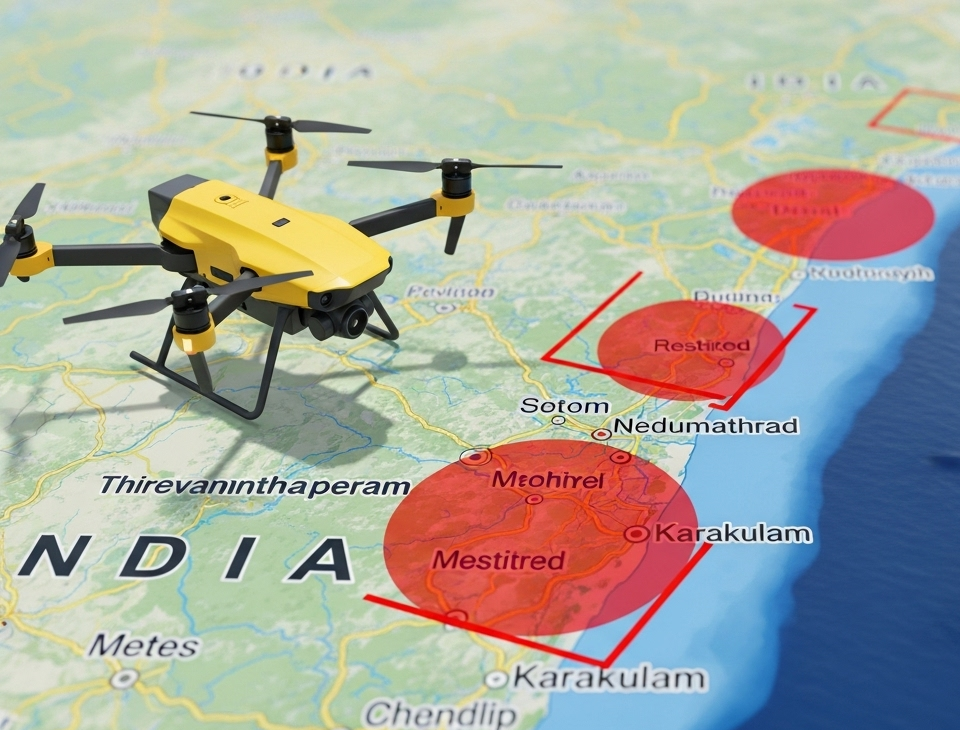
Under the newly issued directive, the operation of drones, lantern kites, remotely piloted aircraft, and any other unmanned aerial vehicles (UAVs) is strictly prohibited within a 2-kilometre radius of designated high-security sites. These locations include:
- Vikram Sarabhai Space Centre (VSSC), Thumba – ISRO’s flagship space research hub responsible for launch vehicle development and satellite missions.
- Liquid Propulsion Systems Centre (LPSC), Valiyamala – A critical facility focusing on the design and development of liquid propulsion stages for launch vehicles and spacecraft.
- ISRO Inertial Systems Unit (IISU), Vattiyoorkavu – Specialises in advanced navigation, control, and guidance systems crucial for India’s space missions.
The security ban also extends to APEP in Aluva, where key propellants for rockets are manufactured. Given the sensitive nature of the work at these sites, state authorities have deemed it essential to create a protective airspace buffer to safeguard both the infrastructure and personnel working in these facilities.
Officials have emphasised that the restrictions are non-negotiable and that any violation will invite legal action under applicable security and aviation laws. Law enforcement agencies have been tasked with monitoring compliance, including the deployment of surveillance teams to detect and prevent unauthorised aerial activity.
This measure comes amid growing concerns worldwide about the security risks posed by unmanned aerial systems, which can be exploited for espionage, sabotage, or other disruptive activities. By enforcing a no-fly zone around ISRO’s research and production centres, the Kerala government aims to eliminate potential threats to India’s space programme.
The public has been urged to cooperate fully with the directive, with officials noting that even unintentional breaches will be treated seriously. Authorities also reminded drone hobbyists and photographers that prior clearance from competent authorities is mandatory for any aerial activity in restricted zones.
This step reinforces India’s commitment to protecting its strategic scientific assets and ensuring the uninterrupted progress of space exploration and satellite development efforts spearheaded by ISRO.
